
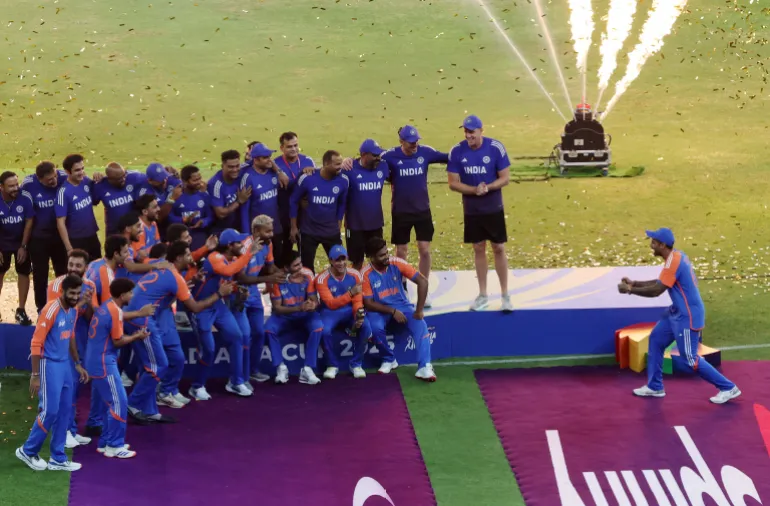
Asia Cup Conundrum: Sports, Politics and Limits of Tolerance!

You have a neighbour who has waged war against you for over 75 years—militarily as well as through terrorism. Throughout this time, you have tolerated, responded only when provoked, and shown restraint rooted in cultural tolerance. But when your civilians are massacred in cold blood, while on holiday with their families, tolerance begins to border on cowardice—unless there is an adequate response. At that point, it is no longer a dispute; it is war.

We often hear the wise say that sports and politics should not mix. Yet this advice seems much easier to give than to follow. When your nation is reeling from continuous bloodshed, shaking hands with the enemy—even on a sports field—feels like an empty gesture. In such an atmosphere, sports inevitably becomes secondary.

So, what is the solution? At first glance, it seems simple: do not play against the enemy. Do not send teams there, do not host theirs, and halt all cultural and sporting exchanges until the situation stabilizes. Straightforward enough in bilateral contests. However, at global or multi-nation tournaments, the question becomes more complicated. Opting out of participation does send a firm and symbolic message, but it also carries significant implications. It denies athletes critical opportunities, undermines the competitiveness of tournaments, and deprives fans of the very essence of sport—the contest.

Sport today is not a pastime but a global industry. Millions depend on it for their livelihood. Unlike engineers, doctors, or bankers, whose professional careers can last decades, athletes have a brief window to perform and earn. Every contest counts—it is the culmination of years of preparation. Too often, when we call for boycotts, we overlook this reality.

This brings us to India’s recent situation. The seemingly easy answer was: India should not have participated in the Asia Cup. Indeed, political opponents and public voices called for a boycott, supported by hashtags and even street hooliganism, such as breaking televisions showing the games. Yet, they ignored the larger impact. If India withdraws from multilateral competitions, the International Cricket Council (ICC) suffers financially. With the majority of sponsorships dependent on India, ICC events would struggle to survive without Indian participation. Experts from England and Australia often remind India that, as the “big brother” of world cricket, its presence is essential, even at the cost of its own sentiments.

Pakistan, on the other hand, benefits from this structure—its cricketing system survives on revenues generated by Indian audiences and sponsors, even while its administration fuels terrorism across the border. This paradox places the BCCI in a Hobson’s choice. And yet, India’s government, understanding global responsibilities and long-term implications, allowed participation in the Asia Cup.

But what of the players, caught in this crossfire? They are professionals contracted to the BCCI, with little personal choice in the matter. Their only avenue to express solidarity with victims and dissatisfaction with the situation was symbolic gestures—most notably, refusing to engage in handshakes. Predictably, critics labelled this “unsportsmanlike,” ignoring the hypocrisy: those who insist politics should stay out of sport are often the first to inject it selectively when it suits them.

The controversy intensified during the presentation ceremony. Pakistan’s Interior Minister, Mohsin Naqvi, who also heads the Asian Cricket Council (ACC), insisted on personally presenting the trophy despite India’s objections. An administrator’s role is to serve the spirit of the contest, not personal ego. The winners receiving their prize is more significant than who hands it over. Naqvi could have easily avoided the controversy by delegating the task—but instead chose political theatre over sportsmanship.

India, ultimately, lost nothing of substance. The team secured a record eighth Asia Cup title. The trophy presentation, or lack thereof, is symbolic—the real loss was to the credibility of the ACC and its leadership, who failed to uphold the dignity of sport.

So, what lies ahead? Possibly, the end—at least temporarily—of ACC championships. Even in Pakistan, voices may rise against matches with India, as public humiliation must have intensified with off-field drama. For decades, India alone bore the burden of choice—whether to play or not. That equation may finally change, with Pakistan’s administration beginning to feel the pressure of its own public sentiment.

Fly On The Wall Catches…………………Achhoo!

Sorry, have been flying around, so no contact. Heard this when I was a fly on the wall somewhere..

Small Boss (b): Sir, this is brewing into a big problem.
Big Boss (B): (snaps out of his snooze with a Homer Simpson drawl) Brew, ahhaaaa….I love my brew. How can brewing be a problem?
b: Sir, I mean the cricket scandal; this spot-fixing by cricketers may fix us.
B: (suddenly sits up) How?
b: Well Sir, obviously everyone will think if cricketers are so corrupt what about the cricket board?
B: How can people connect cricketers to the Board? We said and did nothing when IPL kicked out cricketers, did we?
b: Errrr..well, (coughs), sir, we sort of managed it…newspapers did report Sports minister’s complain to his counterpart about being snubbed and a national insult and all the patriotic emotional…..
B: (cuts him off) Well, that is just standard political rhetoric. Does not prove our connection to the players. If anything, it will prove to the world that the government is also operating as per international standards like that…what do you call it? (snaps his fingers) aaha, the ISO!! But anyway, I do accept that we have to be seen to be doing something. After all, that IS our job. What do you think?
b: Well, sir,we can put the blame on an external influence…(winks)
B: Aha! Got you now. We better stay out of this whole thing, or we will have to answer the fans and government or even intelligence agency…(shiver runs through him) now, that could get messy. So the best outcome will be blaming BCCI and/or Indian government. The gullible fans will just lap it up. We can probably motivate some government official to blame Indians somehow?
b: That would be most wise, Sir. Batting, bookies and Indians are synonymous anyway. Remember John the bookie? I think if we dig hard enough, we can discover a Moolchand somewhere??
B: Moolchand?
b: Moolchand or Mazhar, what’s in a name, Sir. If he is a bookie, he out to be Indian!
B: Good, call the High Commissioner to London; time for him to start paying back for all the bloody free tickets he has been enjoying. It is best that government handle this or we can offend cricket’s Big Brother…and as you know, without Him, all our high-flying lifestyle will come down crashing!! Also tell the coach this time to keep his mouth shut unlike the previous one, who spilled the bloody beans on the Sydney test!
b: Sir, with all the due respect, we may still need plan B. You know what, Sir, its a pity that we were not playing at home..
B: Why do you say that?
b: Because then our intelligent agency would have “explained” that video footage evidence suitably. Unfortunately we are dealing with Scotland Yard..
B: (with a large grin showing paan-chewed, gold-capped teeth): You gave me an idea Chhotu. Isn’t it correct that even though we are playing in England, we are the host nation? So we can claim we are still the host board for this series. We should have home advantage and hence we can summon our police to do the investigation instead of the Scotland Yard! Problem solved!!
b: Umm, Sir, but the home series was against the Australians. Against England, we are visitors.
B: Oh well, ok. May be I should keep my eyes open in the meetings! Bloody meetings, why do we keep them after Lunch? Anyway, that will be our plan B.
b: What exactly are you saying, Sir?
B: Well, I tell you what. If the players have not left the country after completing the home series, they are, technically speaking, still at home!!
Chhotu looks stunned!! And seems like that is not a first.. Big B continues.. 
B: Plan B; let us blame the ECB for bringing in foreign police to do the investigation. Frankly, my dear chap, it is racism!! And to be perfectly honest, our intelligence agency would do a lot better job than Scotland yard. They have received plenty of recommendations from foreign governments like India and USA!!
b: Well, Sir, ECB has actually been very kind to us in hosting Australian series. That may not go down well..
B: Well, Poms need Pounds too. Don’t worry, I will explain it all to that fellow, what’s his name…ah well, whoever, when we meet at the Champions League T20 retreat in South Africa… He understands sub-continent politics quite well…
b: Brilliant, Sir, as usual…aap ka jawab nahi..Just for my curiosity, do you seriously believe there is Indian hand in everything wrong happening here?
B: Absolutely..no doubts.
b: Even in natural disasters like the floods, tropical cyclones, earthquakes etc?
B: Of course. I am amazed you can’t see that, Chhotu. May be that is why you are small. India gave us the wrong side of the land. But more importantly, if they had not separated, it would have been India suffering now! I tell you, they are rogues..
b: (opens his mouth to say something but words do not emerge)….
B: I must confess though, that I do not see Indian hand in everything.
b: So are you really saying there was some calamity in which there was no Indian hand? Which one Sir?
B: Well, the tropical cyclone Phet, which hit us hard and completely missed India!
b: So you are saying that India was not responsible for the cyclone Phet, correct?
B: I didn’t say that Chhotu. I said, there was no Indian HAND in that. There were plenty of Indian mouths!!
b: (almost falling off his chair) What?
B: Well, I tell you; mark my words my dear chap. It was those billions of Indian mouths that were blowing hard at the cyclone and diverted it from their western sea coast to Karachi!
b: (suddenly tumbles out of his chair and touches the feet of Big B): Tusi badi top ho Sir! Now I know why no one except you deserves to sit on this chair..

Been sneezing since…Now I know how even a fly on the wall catches cold!! 

Not Happy John!

So John Howard, ex-PM of Australia has failed another “election”. In some ways you can say that he lost a winnable one this time unlike the one he lost to Kevin Rudd in Nov 2007. I honestly thought he would have got used to loosing by now! Apparently, you can neither take out the politics from the politician nor a politician from politics!! Most Pollies in all countries have a very sharp sense of smell; they will smell-out power even from a chook-raffle! Top level sports administration, obviously represents a pot of honey to a bear; especially to those who are missing their power-fix. And when a sport interests lots of people and spins a few bobs, it is certainly like a full syringe to a junkie.

But you can fool some people sometimes. Little Johhny is now facing the barbs from the thorns he nurtured during his tenure. While he did some excellent work to turn Australian economy around, his ultra-conservative beliefs could not adept to the fast changing canvas of this small but increasingly multi-cultural society. For whatever reason, even at the peak of his powers, he was viewed by many (and not necessarily coloured population only) as a torch-bearer of long defunct white-Australia policy. His utter refusal to apologise to the aborigines for whatever reason, did not help his cause. For all I know, he may be merely simplistic; convinced that anything different from his belief does not merit any attention from him. Fair enough, for an individual. Unfortunately that is not a trait of a leader. Great leaders never divide; they have a gift to unite the most diverse. Looking at the diverse nature of ICC, where 10 full member countries represent a myriad of colours and cultures, I was surprised that Cricket Australia manipulated Howard above what would have been a very welcome candidate like the kiwi Sir John Anderson, especially when Australia already had their turn in Malcolm Grey. All those detractors crying foul and complaining today about subcontinent’s so-called power “abuse”, very conveniently forget that CA did exactly the same by bullying New Zealand cricket. CA did that simply because they could. Those who live in glass houses don’t throw stones at others.

While Australia and New Zealand had an option to choose their representative to head ICC, their representative was eventually going to represent all member countries. With an incredibly complex cultural mix of ICC, what you need is a candidate acceptable to all. If CA had applied that criteria, Howard would have failed in CA’s board room itself. I am sure CA board members are not naive. So the obvious inference is that they wanted to bring in Howard as their Axe-man; someone who would not hesitate to seek and chuck out the “rotten eggs”. After all, those backward third world and corrupt countries can only produce corrupt leaders who are now corrupting the beautiful English game. Why is that so hard to understand? What all the “chest-beaters” in Australia (I can actually hear a giggle from across the Tasman sea!) conveniently forget is that CA (probably with support from England) tried a political stunt which back fired. It happens; get on with it.

In politics, there is a critical process called face-saving formula. What now, is the face-saving formula for CA? Re-nominating Howard would be provocative and more importantly, likely to get  snubbed again! I am not sure if CA is actually that masochistic! Sir John Anderson is hardly going to accept the used-towel nomination, especially when his claim to the nomination merited first-choice. In fact I can see NZ completely washing their hands off this affair. CA can dig in their heels and refuse to nominate any one. That will certainly look churlish. Like it or not, political and economic reality is that CA has to participate in this process as a part of ICC board and nominate someone who can take the attention away from this affair and still become a respected board member and a fantastic representative of all cricket playing countries. Some one like Gideon Haigh (who seems to have a one-point agenda of BCCI bashing) claims there was no better nominee for CA than John Howard. Get real Haighy; Mark Taylor will be well respected and will contribute towards bringing closer, all cricket boards. And that is lot more worthy cause than mending the ruffled ego of little Johny…

ODI to become HDI (Half Day International)

Cricket Australia has taken a bold step in revamping Ford Ranger cup (Domestic limited overs cricket tournament) by deciding to make them as split-innings one dayers. I like it. I hope they still maintain 50 overs per innings, rather than making it 2 games of T20 each. Obviously there are arguments for and against this. Those against it are worried that batsmen will struggle to restart their innings after fielding for 25 overs; spectators may shun first “innings” (20 or 25 overs from each side) and watch only the second “innings”, etc. Ricky Ponting is reportedly not totally impressed with CA’s announcement before any kind of consultation with the Australian players. In today’s Sydney Morning Herald, Channel Nine is quoted to be seeking all ten wickets in the second part of the split innings, making effectively a separate game altogether. The article also quotes English second division’s trial in split innings games. Apparently it has not received plus marks because “Coaches in that competition have expressed frustration over matches essentially decided in the first innings when a batting line-up folds”. Channel Nine’s Brad McNamara claims the patent on ODIs saying “…We would really like the batting order to start again, if you take that away then we’ve got a few concerns about how that might pan out.” Basically Commercial TV networks are merely aiming at the entertainment value of the game, in the name of improvement. While Channel Nine’s claim to the inventions of ODIs are undisputed, the quote “‘Not everyone is going to get a bat, but it’s about getting the best batters to bat twice. Last summer we saw Chris Gayle dismissed in the first over and the game was over”; is a joke! If CA follow that advise, even when the team will comprise of 11 players, some may be just spectators on the ground! In the greed for the cash, commercial channels seem to be forgetting that the game’s developmental aspect comes first and for that, opportunity to budding cricketers rather than marquee players must dictate the path to improvement.
I am sure we all have experienced the thrill of emergence of a new star when the established stars have failed to deliver. While the huge amount of money in the game is definitely due to television rights, they need to remember that ultimately it is the spectators who will determine the fate of the game and the value of their TV rights. And at present spectators are not greatly enamored by what they see in 50 overs cricket, in spite of what Ricky Ponting may feel. The game does need a bit of revamping and I am convinced at least trialling split innings is a way to go.

I am also not convinced about some objections to this innovation, especially those about the players needing to refocus on their innings after fielding for 25 overs. As the game has grown, there has been a constant demand on the skill level of players. A run rate of 4 per over that counted as fast in 70s has become almost normal  today. In transition from test cricket to limited overs ODI to T20, the demand has always been upon the batsman to start scoring runs straight away. The luxury of getting “your eye in” is a thing of the past. Majority of the players coming through the system anywhere in the world with competitive domestic cricket set up, are now used to the demand to maintain  a run rate of more than 4 runs per over. Factors like covered wickets, consistent wicket preparation standards and better equipment have helped but the major change has been to the mind-set of the players. Thus current international player is already adjusted to the requirement of readjusting their focus. Playing competitive cricket at night was unthinkable in my time, but today’s players are able to tune their biological rhythm to give their best even at the time when our bodies struggle to stay in peak performance mode.

While the changes may have been forced upon due to 50 overs inning becoming very predictable and sudden huge popularity of T20, I believe the real reason for improving should be the empowerment of bowlers. What has happened with the advent of slam-bang cricket is an almost annihilation of bowlers due to feather-bed wickets, shorter boundaries, better equipment and some stupid, batsmen friendly rules (like one bouncer and leg side wide). I believe we need to restore the balance in the game by giving something back to the bowlers.

In huge number of ODIs, often side winning the toss ends up gaining significant advantage; sometimes so much that the second side is always playing catch up. This is especially true in day-night games where external factors like dew play havoc with the bowlers. Split-innings will reduce the impact of this to some extent. If on the other hand the wicket does a bit, the side batting first will have some opportunity to exploit that as well.

Even though a side batting first does so only for maximum 3.5 hours in the current format of the ODI, often the nature of the wicket changes significantly for the side batting second to have the same condition while chasing. Splitting the innings will provide side batting second some foothold.

This innovation will also demand some new tactics from captains and coaches on how to utilize their resources, over the full game. May be some more work for the dynamic duo of Messrs Duckworth and Lewis, MBE  to come up with split formula (congratulations to the duo on their achievement); gives them an opportunity to earn a full Knighthood!!

Neither here nor there..

It was not surprising that Aussies and Ricky Ponting have started their preparation for the upcoming series against Pakistan. If you are looking for details on a cricket camp you sadly underrate Aussies. Their preparation begins by hurling a few testing verbal bouncers at their opponents. Ponting decided to “compliment” the new Pakistani test captain Shahid Afridi (any one remembers how many have come and gone?). Nothing new there. Aussies believe in softening the opponent captain first. However the quantum of statements about Afridi (“He hasn’t played much Test cricket of late, has he?” OR “he’s….not necessarily one of their best Test players” etc), especially after winning the last series, tells me that he may be a tad worried about Pakistan team getting together under this new captain. Read his last sentence…”…we just have to make sure we’re focusing on our little things to be the best team we can be when we play them.” Lovely! If you read that last sentence without the benefit of full text, you may be excused for searching for the rising Sun in the west! Don’t worry, Ponting and Aussies are as consistent as the heavenly bodies!! But hey, what is this “..I think we can sort him out in Test cricket for sure” thingy?? Mate, you don’t have to worry about sorting this opponent. If the last series is any indication, they are champs at doing it themselves! Aussies just have to turn up and leave the rest to their opponents!! I wonder, just wonder, what the Pakistan Board is planning, though. If you are seriously doubting your own team for loosing games for money, I wonder how can you keep this series clean that is being played in England, where there are huge number of Pakistani ex-patriots? May be by sweeping previous decisions under the carpet!

Is this “Match fixing” मौसम or what? Doubts are also probably raised about the Indian team’s performance in Zimbabwe! There is hardly anything worthwhile writing about the two “shocking” losses to Zombies…oops, Zimbos. What is surprising is the facile win by Indians against Sri Lankan team in the first game, probably the strongest team on paper in the comp. So are Indians being “obliging” guests? A few wins against a highly ranked team can divert the attention off the beleaguered Zimbabwe Cricket Association. Remember how Bangladesh got the nod of ICC? While not detracting from the terrific performance of the Zimbabweans, they may have benefited from the charitable gestures not only from Harbhajan Singh, but also the India selectors! How else can you explain experienced pacers like Ishant and Appam cooling their heels when a completely new look, new ball attack opens for India? Every time a team plays, it has to do so with the respect for the opponents. Sadly, Indian selectors have forgotten that. Or is it that India and Sri Lanka have decided that the hosts must play the finals; the opponents will fight it out for a spot in the finals??  It looks like Indian team management is absolutely committed to experiment in this series even at the cost of being thrashed. That can constitute match-fixing of a sort, isn’t it? Your guess is as good as mine. Seems to me that match-fixing is a disease easily traversing across the LOC!! Poor Raina is on a hiding to nothing…

Some very very interesting things have emerged from the whole IPL mess..I would strongly suggest all  read the copy of email from ECB Chairman Giles Clarke to BCCI President Shashank Manohar. Modern soap opera. If it is made into a sit-com it can easily give a run for the money to “क्योंकि सास भी कभी बहु थी”. Apparently Clarke himself is not that much popular within England County Cricket set up that makes up the ECB. Majority counties and especially those with major stadia are looking to increase revenue and Lalit Modi’s proposed “rebel league” in England was very interesting. While Modi is being portrayed as the biggest villain to hit cricket, it seems that the men present in Delhi meeting admire him as a visionary. All charges and his “bigger-than-the-game-attitude” notwithstanding, his contributions to BCCI and Indian cricket can not be denied. I hope current BCCI stake-holders understand that sooner than later. In last couple of days it has become apparent that the typically Indian ‘Narangi” (mandarin) unity is being exposed as the skin is being peeled off slowly in this IPL mess. Seems now that Sharad Pawar and even the interim  IPL chairman Chirau Amin are as “clean” as Lalit Modi and Shashi Tharoor. Looks like Modi is on a course to take a few down with him. Does it mean that the English motto of “Divide and Rule” will succeed again? Empire Strikes Back?? Will money win over the beauty of this game? Will the real Gods of cricket like GGT (Great God Tendulkar) become merely the ushers to the virtual Gods of Cricket like Modis, Clarkes, Pawars?? Keep watching the drama…at least it is better than the insipid cricket Indian team has been dishing out of late!! Legendary Kishor Kumar is blaring out loud and clear on my stereo “पैसा यह पैसा, कोई नहीं ऐसा, यह हो मुसीबत, न हो मुसीबत…”
Cheers Folks..

Pakistan embroiled in Match fixing…again!!

Heard that ICC’s anti corruption bureau has been investigating Pakistan’s tour of Australia..goodonya ICC! A bit late but देर आये दुरुस्त आये; better late than never. Or is it a case of “oops, we missed the most obvious so better start doing something now” syndrome? It smacks more of politics than a real intention of doing something good for the game.

Years back when Salim Malik, Mohammad Azaharrduddin and Hanse Kronje got exposed as match-fixers I could not believe any player would throw his innings (as a batsman I never wanted to get out) or his pride as a fielder to drop a catch or miss a stumping deliberately. I often spent sleepless nights for dropping a hard chance or a stumping while standing up, playing backyard cricket with a tennis ball on wet concrete floor. And I am sure I am not alone. What is it that makes a player do so? I still find it hard to believe that when for elite cricketers there is so much money to be made legally, a player would tank his game for money…isn’t pride in your success at least, as much important as money? Or am I too old fashioned? It is still difficult to digest that cricket may have changed so much where a man would not hesitate to sell his sporting achievement for a few bobs.

Of course, now there is enough smoke to infer that there must be fire; may be just a small amber burning somewhere. I was convinced about that after the Sydney test this new year. Pakistanis definitely tanked that game; Aussies had no business wining that one and all that brouhaha about the best win from death and all that crap was just that, crap!! Pakistanis lost, plain and simple. I have seen videos of Kamran Akmal’s keeping in that test a few times and could not believe that any wicketkeeper would go through such a horrendous spell in a day; not even a sixth grade, 130 kg, wide as a barn door and no-where-else-to-hide, reluctant with gloves and pads, back-stopper..In my opinion Akmal missed those catches, stumping and run out deliberately. What is not clear is, why? Could be for money or for proving a point?? May be the Pakistan camp was so badly divided that Akmal took it upon himself to “stamp his authority”..or may be he thought he could kill two birds with one “glove”, make his point and earn some dough? Wicket keeper is the engine-room of the fielding side and his abject failure can corrode the morals of the fielders quite easily and quickly. Akmal’s performance that day is an example of that.

There was sufficient doubt about Akmal’s performance even within the Pakistan camp when the coach Intikhab Alam asked his keeper to fall on his own sword. That done, somehow he returned to Pakistan team for the T20 world cup. Does it mean that if Akmal fixed the game, the team selectors have an equal role to play in the drama? How else can one explain his return? Probably all thought, Akmal behind the stumps, is the only fool-proof plan to lose!! May be everyone is on the gravy train!!

Then again, when your country is in strife like Pakistan is in today and suicide bombers are dime a dozen, it must be hard to keep focus on cricket. Pakistan as a state is falling on its own dagger; one that it has used for long against its neighbor is now aimed at its own heart. Terrorism, a product which was designed strictly for export market has now become a huge commodity for local consumption. Probably a poetic justice, but very sad! It is a chaos out there and the cricketers are only humans. What do you achieve by winning a cricket match when the value of humanity is next to zero? When there is no pride in winning, there is no pain in loosing. May be then the allure of money takes over. What a pity! I hope I am wrong since I am convinced that Indian V Australia is still a distant second to the Mahabharat of Indian V Pakistan..get your act together Pakistan. Believe it or not, you have a huge fan followers within India..even traditionalists would love to see Pakistan cricket up on its feet and playing trademark hard fought cricket…

Little Johnny to become Top Dog in Cricket

Australia and New Zealand have nominated ex-Australian Prime Minister John Howard as their candidate for the post of ICC president. It is amazing how New Zealand will always remain a small brother. Long term and proven cricket administrator from New Zealand Sir John Anderson was hoping to be nominated but was left holding the wooden base while the trophy was “stolen” by self-proclaimed cricket tragic, John Howard. I reckon poor Anderson has been hit for a “sux” (“six” for those uninitiated in Kiwi accent). There are even accusations of bullying  tactics by Aussies. Read this interesting bleat from NZ Herald. I believe the kiwis need not try anything in future, just give in to the elder brother..after all, sheep-power, doesn’t account for much, does it?
John Howard was a Prime Minister of Australia for almost 12 years and his reign coincided with good economic reforms and sound fiscal condition. I am not sure though, how much was his contribution to that. He was a smart politician though. Please ask his deputy who was kept waiting for ages after having been promised the top position, just because little Johhny changed his mind. But all that is a part of politics; I have seen worse in India. My beef is, that is if I have one at all, how come John Howard suddenly came into the picture for Cricket Australia? What prompted CA to nominate a political heavy weight, who has neither played much club cricket nor administered ANY cricket club let alone represented a state organisation? In fact, he can hardly be called even a sportsman, at least in my book. All in Rubgy playing countries would remember his sour-puss face while handing out winner’s medals to English team who beat Aussies in the Rugby World Cup final of 2003 in Sydney..classic sour grapes stuff that. But the behavior from the Chief Guest at a prestigious event and that too from the reigning Prime Minister of the host country, my dear Sir, can hardly be called cricket! Anyways, we can all forget that. No one likes loosing; whether playing or following, especially a one-eyed Aussie. If anything, it confirmed little Johnny’s immense love for the game of winning. I can live with that, especially as the recipients of his sourness were Poms; better known as the Kings of the Whines. But Howard’s foray into cricket administration is a completely different kettle of “Bombay duck”. I will come to that soon.
What, apart from his self-proclaimed love for cricket and a great understanding of wheeling and dealing as a politician, can Howard bring to the table that can help the game of cricket? Honestly, very little. ICC is by and large a toothless tiger and its Presidency a mere ceremonial position. What can he do that will impact upon the game? When an organisation depends upon its component members for its existence, it can hardly command respect. To be brutally frank, ICC is hardly in charge of the game. It is run by individual boards. Even after having every game now conducted by independent officials appointed by the ICC, it is still dependent upon its members for the revenue. This is the legacy of the Lords of English and Australian cricket who ran their fiefdom for ages by disregarding the power of masses (they can go and play football!!), concentrating on more important things like their gin and tonic, tea and scones. To that effect, BCCI is perhaps, the new Zamindaar. It was perhaps lucky that Indians and other subcontinent population took to the game of the Gora Sahibs like duck to the water. However BCCI has to be credited for a significant effort in taking the game to the masses rather than keeping it as an exclusive past time for the royals, as was the case before India’s independence. It is this power of masses that has changed the game for ever and given the subcontinent a force to loosen the stranglehold that England and Australia had over the game, in spite of doing precious little for the advancement of the game. I can not see any change to ICC’s ability in future to exercise similar clout without the contributions from the subcontinent.  Let us face it, for any game to prosper or indeed survive, participation is the key. English and Australian administrators were culprits in my opinion, of making the game exclusive for their elites. Probably Australian cricket administrators, definitely at local levels, can still be blamed for continuing that attitude. Much as Australian cricket team is thriving, one look at the junior rosters will indicate that the number of participants is hardly increasing. Compared to that, the scenario is completely different on the subcontinent. It is played, followed, seen and beamed live in subcontinent, more than any where else. With over 50% of world population as potential followers of the game (I am sure Chinese are coming!), and currently generating over 70% of revenue, how can ICC hope to equate its clout with the subcontinent boards, is frankly beyond me. One can be excused then, for thinking that ICC shall remain toothless and its Presidency a mere ceremonial position for a significant period of time.

My suspicion is that CA’s sudden love for John Howard emanates from the stand BCCI has taken by promoting Sharad Pawar to the position. Another politician of immense and one of the longest surviving “Ya va chandra Diwakar” (till moon and sun shine) clout in India whose name is synonymous with “Power”. Pawar like Howard has very little to offer to International cricket; in fact his only contribution to Indian cricket, if it can be called that, is to displace Jaggu (Jagmohan Dalmiya). That is of course as far as I know, and I stand corrected.
For those who may be unaware of the Machiavellian nature of International cricket administration, may not know how this typically English game suddenly became the Goddess of the subcontinent. It was BCCI run by Jaggu who wrested this prized possession from the grasp of blissfully unaware and sleeping Lords; blissfully unaware of the potential explosion, if it could be taken to the commoners. Much-maligned Jaggu the Marwari, who can squeeze a dollar out of every cent in anyone’s pocket, sometimes even before it is earned,  is to be credited for supreme financial position BCCI has reached as one of THE richest sporting bodies in the world.  And by default ICC and ALL other cricket boards in the world are enjoying the fruits. ICC has been living a life of default for ages..that is the nature of the beast. Due to Jaggu crashing the Lord’s party in the Long Room, ICC had no choice but to set up a rotation policy where cricket board of EVERY full member country playing the game, would nominate President for a period of 2 years. Before this, every decision was taken at the behest of the England and Australian boards, who even had the veto power. Jaggu was the first “democratically elected” ICC President. For those interested in reading further, please read Graham Halbish’s biography “Run Out”, where he mentions about “Project Snow” to counter the alleged threat in 1997, from BCCI and other subcontinent boards to split the game on the basis of colour, if Dalmiya, who had more votes than Malcolm Gray of Australia, was not elected to the Presidency of ICC. Due to that rotation policy, better known in my book as “agree or loose our chaddis” democracy from the Lords, Sharad Pawar will be the ICC President from 2010 to 2012 and now, little Johnny will do the honour from 2012 to 2014. Sorry for the detour folks.
There is though, one corollary to the above presumption that ICC will remain toothless for a long time. It can change, if BCCI itself decides to make ICC stronger! It will be effectively same as before with India being possibly a bigger partner at the table shared by England, Australia and perhaps SA. It will be interesting to see what Sharad Pawar does when he takes over. That can change the complexion of ICC and then Howard’s appointment can become meaningful. To my mind, that seems to be the only way forward for the English and Australian boards. Even if that happens, I can not see BCCI loosing its stranglehold on the money purse and power reins within the ICC; unless of course new members like China and USA tilt the balance away from BCCI. A distant possibility.
That brings me to the Bombay duck and curry pies. Any one who takes up the top job of running cricket (heck, that is not correct, ICC ruins more than runs, but I will let that go to the keeper), will need to become extremely aware of the sensitivities of the subcontinent. No doubt little Johnny has the wherewithal to wheel and deal; it has been his life. But it will be an interesting challenge for him to adjust to the colour of cricket these days. Based on his performance as the Australian PM, one may be excused to doubt his ability to sit through a Bollywood show without cringing. Having said that, I have a feeling that he can adept to it because that was his only positive point. The only point of interest is, whether he will be a meek ICC President or try to impose as is his nature. As a part of previous British Commonwealth, sub-continent countries especially India, have developed a very sensitive skin to perceived racism. Earlier the population accepted that as norm and moved on. The current generation, having exorcised their demons have become very expressive and often, rightly or wrongly, tilt to the other extreme. In this climate, an obstinate personality like John Howard will face some very stiff challenges to convince the significant half of the ICC that he represents every one. I fully agree with Murlidharan, who once decided not to tour Australia after copping sledging from the then PM, John Howard, about his bowling action! People have long memories. Little Johnny may fancy himself as a bit of a spinner, but he may find himself eating a humble curry pie. I am not sure if he would like that..
May be John Howard can bring something to the table; may be he can achieve as ICC chief what he could not do as a PM. A possibility, but can he, a staunch monarchist with strong conservative mindset (why is he called liberal?) rise above his prejudices? You know what, politics HAS bred stranger bed fellows than Pawar and Howard…

Is test cricket at night more sexy?

Had India failed to win today’s test, there could have been numerous Indian journos asking why BCCI refuses to play test cricket under flood-lights. Well, there is some merit in that argument; Indians lost close to 55 overs yesterday due to bad light/rain and if flood lights were permitted, they could have put in some overs out of that. They came close to loosing an opportunity to square the series and stay on top of the ICC ranking. For now, at least, calls for BCCI to join in an attempt to search for flood-light solution to test cricket may not rise. Of all boards, BCCI has been talked about as an autocratic board which does not hesitate to milk Indian cricketers as cash-cows. But they some how are not falling in with other cricket boards on this issue. Call BCCI traditionalist or just bullish for not joining other cricket boards, especially two powerful lobbies in world cricket namely Cricket Australia and ECB who are very keen to play test cricket under flood-lights as early as within next two years. I don’t know why; but I don’t mind that decision. I am not arguing this only on emotion that test cricket should remain traditional. Do we really need test cricket to be played at night, is my question.

Apparently it is argued that revenue from audience attendance for test cricket is diminishing and something needs to be done to attract the crowds back. Many administrators of the game seem to think that making test cricket a day-night affair will achieve that. They are convinced that this is the only way test cricket will survive. I am not sure about that. I believe economics of the game of cricket is based upon TV revenue more than audience attendance in stadium. It is a fact that any test series will make money if it is sufficiently attractive for subcontinent fans. More than 70% revenue from TV rights for any test series is generated by Indian corporates. Crowd attendance is hardly important. Now with ICC getting its fair share of cut from every TV deal and then sharing that revenue with ALL member associations, Indian corporates have become cash-cows for all cricket boards in the world. If there is sufficient interest on the sub-continent in a test series between any two nations, it will become a profitable proposition regardless of the number of spectators. I do not like that situation, but that is reality. And looking at some closely contested test series in recent times (Ashes in England, SA-Eng in SA, India-Australia, India-England and even India-NZ in NZ), audience have returned to test cricket, at least TV audience if not as much, at the venues. I believe that any series involving India, Australia, SA, England and Pakistan will make money regardless of number of spectators at the venue. Test cricket is alive and kicking; there could not have been a better example of that than today..

However, the powers that be, are convinced that night cricket is the only way forward for test cricket to survive. As you know, white, red, pink, fluoro lime are a few colours  that have been trialled unsuccessfully. This season Cricket Australia trialled a pink ball in some representative games (Inter-state second eleven games). The results were hardly encouraging. The ball lost visibility after ~50 overs due to loss of colour. White ball which is used for ODIs have the same problem. Hence they introduced new rule recently to change the ball from 35th over every game. In test cricket ball is changed only after 80 overs unless it looses shape or is artificially damaged, a la Shahid Afridi. Which means, at some stage if someone comes up with a  night-friendly and long lasting coloured ball, we may see advent of test cricket under flood lights. I am not comfortable with that argument; one reason being, as mentioned above, there is no economic reason to do so.

While I am not necessarily a traditionalist, I would still like to see test cricket being maintained as it is now. I love every new innovation introduced in cricket, like coloured balls and clothing and night ODIs and T20s. But test cricket is a pinnacle of skill and temperament of a player. It separates men from boys. It needs to be kept in its pure form.

There is also another reason in my opinion, to maintain test cricket as such. Every human being has a biological clock within. You normally perform best at a certain time of the day and start loosing physical and mental power as night approaches. I think it would be very difficult to play test cricket under conditions when adrenalin starts to wane and body starts to loose its optimum power, concentration starts flagging. Granted that all international players are now used to maintain optimal level of concentration while playing day-night cricket, I am not convinced that they will be able to maintain peak performance for FIVE DAYS continuously in a test match.

Additionally, drastic variation in playing temperatures from day (35°C) to night (20°C) can cause serious muscle/tendon injuries e.g. If a pace bowler has to start bowling at 9 pm after his batting is done, he may struggle to warm up the body sufficiently to be able to bowl at 150k without damaging muscles/tendons. It may be done after sufficient training regimes are devised, but I suspect the risk of injuries will be lot higher than at temperatures that do not vary significantly, especially when one has to exert for five consecutive days.

One critical aspect of any competition is that the condition should remain relatively similar for both sides. I know conditions change from session to session in test cricket and champion sides learn to conquer that. However, if gripping the ball becomes an issue, I believe that is a significant and unfair change to the playing condition, that actually makes one side less competitive than the other. I am referring to a critical factor that will be encountered in night cricket; dew. Recently we have seen that the dew made ball very wet at night resulting in sides choosing to bowl first under day light even after winning the toss on a flat track.

Test cricket is the ultimate test of a player and a team’s capabilities, skills and attitude; physical and mental. Conditions must be perfect for such an encounter. I believe night cricket will change that significantly so that environmental conditions will become more important than skill. As the late Vijay Merchant would say, that my dear sir, is not cricket.

Care to share your Late Cuts?