You have a neighbour who has waged war against you for over 75 years—militarily as well as through terrorism. Throughout this time, you have tolerated, responded only when provoked, and shown restraint rooted in cultural tolerance. But when your civilians are massacred in cold blood, while on holiday with their families, tolerance begins to border on cowardice—unless there is an adequate response. At that point, it is no longer a dispute; it is war.
We often hear the wise say that sports and politics should not mix. Yet this advice seems much easier to give than to follow. When your nation is reeling from continuous bloodshed, shaking hands with the enemy—even on a sports field—feels like an empty gesture. In such an atmosphere, sports inevitably becomes secondary.
So, what is the solution? At first glance, it seems simple: do not play against the enemy. Do not send teams there, do not host theirs, and halt all cultural and sporting exchanges until the situation stabilizes. Straightforward enough in bilateral contests. However, at global or multi-nation tournaments, the question becomes more complicated. Opting out of participation does send a firm and symbolic message, but it also carries significant implications. It denies athletes critical opportunities, undermines the competitiveness of tournaments, and deprives fans of the very essence of sport—the contest.
Sport today is not a pastime but a global industry. Millions depend on it for their livelihood. Unlike engineers, doctors, or bankers, whose professional careers can last decades, athletes have a brief window to perform and earn. Every contest counts—it is the culmination of years of preparation. Too often, when we call for boycotts, we overlook this reality.
This brings us to India’s recent situation. The seemingly easy answer was: India should not have participated in the Asia Cup. Indeed, political opponents and public voices called for a boycott, supported by hashtags and even street hooliganism, such as breaking televisions showing the games. Yet, they ignored the larger impact. If India withdraws from multilateral competitions, the International Cricket Council (ICC) suffers financially. With the majority of sponsorships dependent on India, ICC events would struggle to survive without Indian participation. Experts from England and Australia often remind India that, as the “big brother” of world cricket, its presence is essential, even at the cost of its own sentiments.
Pakistan, on the other hand, benefits from this structure—its cricketing system survives on revenues generated by Indian audiences and sponsors, even while its administration fuels terrorism across the border. This paradox places the BCCI in a Hobson’s choice. And yet, India’s government, understanding global responsibilities and long-term implications, allowed participation in the Asia Cup.
But what of the players, caught in this crossfire? They are professionals contracted to the BCCI, with little personal choice in the matter. Their only avenue to express solidarity with victims and dissatisfaction with the situation was symbolic gestures—most notably, refusing to engage in handshakes. Predictably, critics labelled this “unsportsmanlike,” ignoring the hypocrisy: those who insist politics should stay out of sport are often the first to inject it selectively when it suits them.
The controversy intensified during the presentation ceremony. Pakistan’s Interior Minister, Mohsin Naqvi, who also heads the Asian Cricket Council (ACC), insisted on personally presenting the trophy despite India’s objections. An administrator’s role is to serve the spirit of the contest, not personal ego. The winners receiving their prize is more significant than who hands it over. Naqvi could have easily avoided the controversy by delegating the task—but instead chose political theatre over sportsmanship.
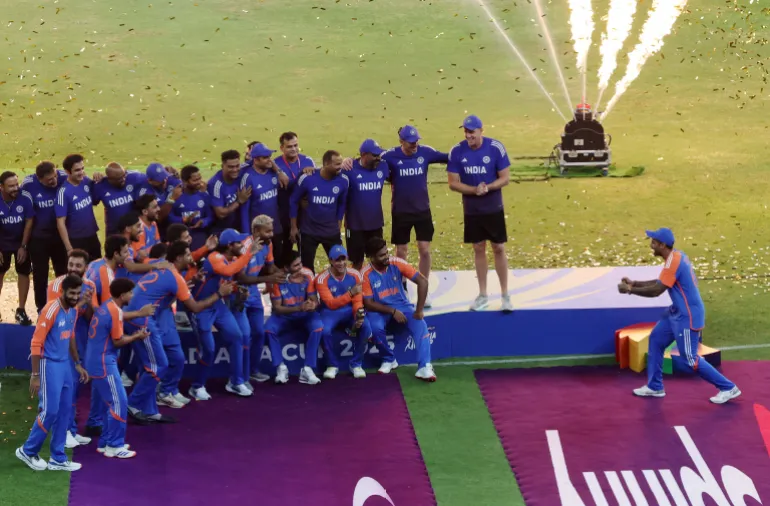
India, ultimately, lost nothing of substance. The team secured a record eighth Asia Cup title. The trophy presentation, or lack thereof, is symbolic—the real loss was to the credibility of the ACC and its leadership, who failed to uphold the dignity of sport.
So, what lies ahead? Possibly, the end—at least temporarily—of ACC championships. Even in Pakistan, voices may rise against matches with India, as public humiliation must have intensified with off-field drama. For decades, India alone bore the burden of choice—whether to play or not. That equation may finally change, with Pakistan’s administration beginning to feel the pressure of its own public sentiment.

 Switch Hit
Leave a comment