
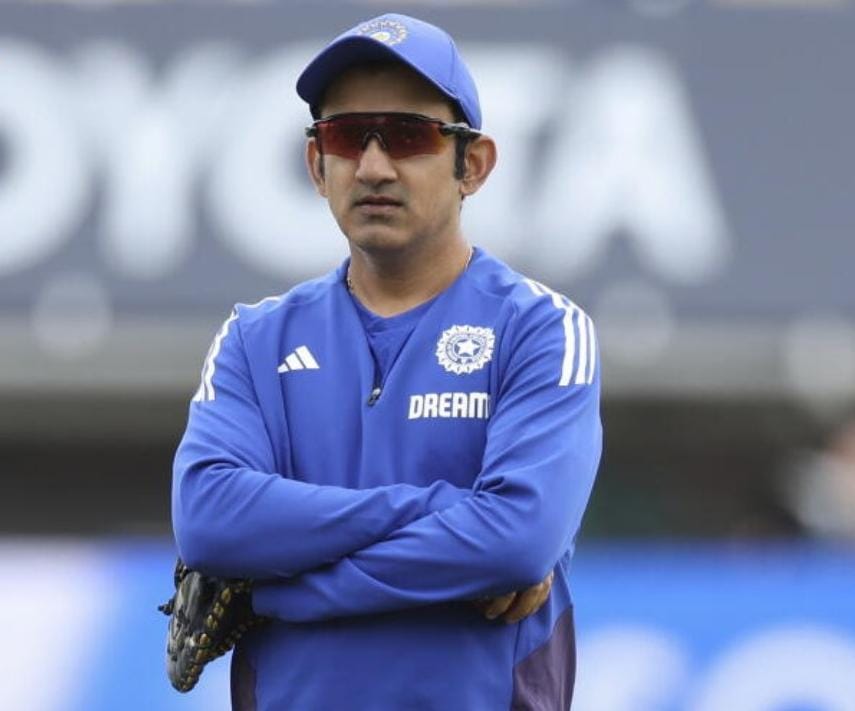
Is the Indian Cricket Team on a Roller Coaster? The Situation is Gambhir (serious)!

Under the guidance of coach Gautam Gambhir, the Indian cricket team has set a few new records. While the team has achieved notable success in the limited-overs formats, it has also suffered shocking defeats in Test cricket and even in the T20 format, where India has traditionally been considered one of the strongest teams. Alongside winning trophies such as the ICC Champions Trophy, the Asia Cup, and the ICC T20 World Cup, India has also produced some unexpected results. These include a 0–2 series defeat to Sri Lanka in 2024—the first such loss in 27 years. Then, just last month, came a humiliating 0–2 whitewash in the T20 series against Ireland. Following that, England thrashed the T20 world champs 4-0; thanks to the rain Gods the series result wasn’t 5-0!

Ever since Gautam Gambhir became India’s coach, he has attracted more attention than the team itself. There could be several reasons for this. Some cricket commentators and social media observers have claimed that his appointment owed more to political reasons than to cricketing credentials. The primary reason for such speculation is perhaps his recent political career. Gambhir’s coaching résumé before becoming India’s coach was virtually insignificant. He had never held the responsibility of coaching any team. His only experience was serving as a mentor for IPL teams for two years, and that too during his tenure as a BJP Member of Parliament from 2019 to 2024. Naturally, such an appointment raises questions, especially when success as a cricket coach is difficult to measure. Furthermore, Gambhir’s arrival coincided with the somewhat premature retirements of senior players such as Virat Kohli and Rohit Sharma. It is therefore understandable why some suspect that his appointment may have had motives beyond cricket. Cricket fans like you and me, who rarely have access to the truth about the inner workings of the Indian team, are often left relying on our sixth sense to separate fact from rumour.

Before Gambhir’s tenure began, India had never suffered a whitewash in a three-Test home series. New Zealand had never won a Test series in India. In fact, no visiting team had won a Test series in India since 2004. All these records were shattered when New Zealand won the 2024 series 3–0. As if that was only a warning of bigger shocks to come, South Africa defeated India 2–0 in a Test series in 2025, once again completing a whitewash. Another unwanted feather in coach Gambhir’s cap. Yes, there are two or three ICC trophies to provide some consolation, but the history of his coaching tenure appears more stained by these failures than decorated by success.

After the collapse in the Test series against South Africa, India went on to win the T20 World Cup. The joy of that triumph overshadowed the Test debacle. But India’s embarrassing T20 series defeat to Ireland has reopened those old wounds. The celebrations following the victory on 8 March 2026 did not last very long. Ireland had failed to progress beyond the first stage of the World Cup, managing only a single victory. Yet, just three months later, the very same team whitewashed the world champions. I agree that India did not send its strongest team to Ireland. Even so, India’s second or third-string side should have been capable of defeating an Irish team that could hardly be regarded as a major cricketing force—at least on paper. But the team’s supporters had absolutely no expectation of such a shocking performance. One question naturally comes to everyone’s mind: Is Mr. Gambhir very seriously preparing Indian cricket fans for even bigger shocks ahead? Results like these are enough to make even an atheist cricket fan start praying!

During Gambhir’s tenure, remarkable victories and shocking defeats have arrived with almost equal speed. Cricket lovers like you and me feel as though we are riding a roller coaster. Winning and losing are both integral parts of sport. But when a team’s form fluctuates so wildly and so quickly, like a yo-yo, it is only natural to feel dizzy. During the 1970s and 1980s, India was famous for its unexpectedly fighting performances. The only problem was that nobody could predict when the fighting Indian team would actually turn up—not even the team itself! Today, Pakistan wears that crown. Looking at India’s current roller-coaster performances, one cannot help but wonder whether Pakistan may soon lose that distinction! Let us hope that either Mr. Gambhir or the BCCI selectors wake up before long.

When Sourav Ganguly took over as captain of India, a noticeable transformation began in the attitude of Indian cricketers. Under Mahendra Singh Dhoni’s leadership, this change became even stronger, and under Virat Kohli’s captaincy, it reached its peak. The circumstances surrounding the end of Kohli’s captaincy remain an unsolved mystery. However, under Rohit Sharma’s leadership, India continued to play with the same fighting spirit and remained a team that was extremely difficult to beat. Yet within the corridors of the BCCI, there was a growing feeling that both Virat and Rohit were approaching the end of their careers. In particular, despite Kohli’s steadily declining Test performances, his stature in international cricket had become so great that removing him from the team appeared almost impossible—especially when the selectors did not receive strong backing from the gentle and accommodating coach Rahul Dravid. Therefore, once Dravid’s tenure ended, it appears that a plan was put into motion to appoint a comparatively inexperienced but firm-minded coach like Gambhir. This suggests that Gambhir’s selection may have been driven less by the long-term advancement of Indian cricket and more by the immediate objective of ushering Virat Kohli and Rohit Sharma towards retirement and rebuilding the Indian team. Whenever established players retire, every team goes through a period of disappointing results. It can certainly be said that, following the retirements of these two outstanding players and Ravichandran Ashwin, India has performed reasonably well overseas. What remains shocking, however, are the two crushing home Test series defeats.

Were these defeats simply the result of changes in personnel? In situations like this, it would be unfair to point to any single reason. However, an analysis of both the New Zealand and South Africa Test series reveals one clear pattern. India’s batsmen struggled badly against the opposition’s spin bowling. The team management requested heavily spinning pitches, but the decision ultimately backfired on their own team. On one hand, they underestimated the quality of the opposition’s spin bowlers. On the other, they overestimated the ability of their own batsmen to play spin. During both series, it became evident that India’s batsmen and bowlers are now more comfortable on faster pitches offering some bounce than on sharply turning surfaces. Over the past several decades, heavily spinning wickets have become increasingly rare in India’s domestic competitions. Most pitches now provide good pace and bounce for four or five days. This is precisely why India has produced a continuous stream of quality fast bowlers over the past two decades, whereas the supply of spin bowlers has not been as abundant as it traditionally used to be. So yes, the batsmen’s inability against spin was certainly one factor behind India’s collapse. But in my opinion, the greater cause was the strategy of preparing excessively spinning pitches. Such decisions lie more within the control of the team management than the players themselves. It seems to me that Gambhir’s inexperience as a coach, combined perhaps with his tendency to focus intensely on a particular idea, may have contributed significantly to this mistake.

Very few batsmen in world cricket—not just in India—have been as accomplished against spin bowling as Gautam Gambhir. Quite often, something that comes naturally to you as a player may not receive the same attention when you become a coach. Instead, your focus may shift elsewhere. Even after suffering a crushing home defeat against New Zealand, Gambhir was unable to alter his strategy against South Africa, resulting in another heavy defeat. This perhaps also points towards a certain degree of stubbornness. It is often the case that when a player becomes a coach, it takes time to develop the habit of seeing the bigger picture rather than viewing the game solely through his own perspective. Furthermore, if the individual is naturally stubborn, changing one’s approach can take even longer. As a coach, one must develop the ability to understand the strengths and limitations of every player in the team—a task at which even the greatest players can fail. I will cite just one example of a truly great player who could not become a successful coach: Greg Chappell. To some extent, the puzzle surrounding coach Gautam Gambhir appears equally perplexing.

For now, the ball is in the BCCI’s court. Only time will tell how long a rope is given to Mr. Gambhir.

ODI to become HDI (Half Day International)

Cricket Australia has taken a bold step in revamping Ford Ranger cup (Domestic limited overs cricket tournament) by deciding to make them as split-innings one dayers. I like it. I hope they still maintain 50 overs per innings, rather than making it 2 games of T20 each. Obviously there are arguments for and against this. Those against it are worried that batsmen will struggle to restart their innings after fielding for 25 overs; spectators may shun first “innings” (20 or 25 overs from each side) and watch only the second “innings”, etc. Ricky Ponting is reportedly not totally impressed with CA’s announcement before any kind of consultation with the Australian players. In today’s Sydney Morning Herald, Channel Nine is quoted to be seeking all ten wickets in the second part of the split innings, making effectively a separate game altogether. The article also quotes English second division’s trial in split innings games. Apparently it has not received plus marks because “Coaches in that competition have expressed frustration over matches essentially decided in the first innings when a batting line-up folds”. Channel Nine’s Brad McNamara claims the patent on ODIs saying “…We would really like the batting order to start again, if you take that away then we’ve got a few concerns about how that might pan out.” Basically Commercial TV networks are merely aiming at the entertainment value of the game, in the name of improvement. While Channel Nine’s claim to the inventions of ODIs are undisputed, the quote “‘Not everyone is going to get a bat, but it’s about getting the best batters to bat twice. Last summer we saw Chris Gayle dismissed in the first over and the game was over”; is a joke! If CA follow that advise, even when the team will comprise of 11 players, some may be just spectators on the ground! In the greed for the cash, commercial channels seem to be forgetting that the game’s developmental aspect comes first and for that, opportunity to budding cricketers rather than marquee players must dictate the path to improvement.
I am sure we all have experienced the thrill of emergence of a new star when the established stars have failed to deliver. While the huge amount of money in the game is definitely due to television rights, they need to remember that ultimately it is the spectators who will determine the fate of the game and the value of their TV rights. And at present spectators are not greatly enamored by what they see in 50 overs cricket, in spite of what Ricky Ponting may feel. The game does need a bit of revamping and I am convinced at least trialling split innings is a way to go.

I am also not convinced about some objections to this innovation, especially those about the players needing to refocus on their innings after fielding for 25 overs. As the game has grown, there has been a constant demand on the skill level of players. A run rate of 4 per over that counted as fast in 70s has become almost normal  today. In transition from test cricket to limited overs ODI to T20, the demand has always been upon the batsman to start scoring runs straight away. The luxury of getting “your eye in” is a thing of the past. Majority of the players coming through the system anywhere in the world with competitive domestic cricket set up, are now used to the demand to maintain  a run rate of more than 4 runs per over. Factors like covered wickets, consistent wicket preparation standards and better equipment have helped but the major change has been to the mind-set of the players. Thus current international player is already adjusted to the requirement of readjusting their focus. Playing competitive cricket at night was unthinkable in my time, but today’s players are able to tune their biological rhythm to give their best even at the time when our bodies struggle to stay in peak performance mode.

While the changes may have been forced upon due to 50 overs inning becoming very predictable and sudden huge popularity of T20, I believe the real reason for improving should be the empowerment of bowlers. What has happened with the advent of slam-bang cricket is an almost annihilation of bowlers due to feather-bed wickets, shorter boundaries, better equipment and some stupid, batsmen friendly rules (like one bouncer and leg side wide). I believe we need to restore the balance in the game by giving something back to the bowlers.

In huge number of ODIs, often side winning the toss ends up gaining significant advantage; sometimes so much that the second side is always playing catch up. This is especially true in day-night games where external factors like dew play havoc with the bowlers. Split-innings will reduce the impact of this to some extent. If on the other hand the wicket does a bit, the side batting first will have some opportunity to exploit that as well.

Even though a side batting first does so only for maximum 3.5 hours in the current format of the ODI, often the nature of the wicket changes significantly for the side batting second to have the same condition while chasing. Splitting the innings will provide side batting second some foothold.

This innovation will also demand some new tactics from captains and coaches on how to utilize their resources, over the full game. May be some more work for the dynamic duo of Messrs Duckworth and Lewis, MBE  to come up with split formula (congratulations to the duo on their achievement); gives them an opportunity to earn a full Knighthood!!

There is God….and then there is Sachin!!

My cup is full…no, no, it is running over! I have been lucky to see one of the finest symphonies ever to have been played on the cricket field. Tendulkar’s unbeaten double ton last night was not merely an incredible achievement being first ever in 39 years and 2961 ODIs played so far, but a real master class. The control with which he coaxed the ball in to the gaps was really seen to be believed. No words can describe the beauty of it. More than the milestone, I was awe-struck by sheer control, incredible placement and almost no violence in scoring at a break-neck speed. There are players who can bludgeon the ball (as Dhoni last night), or dominate the scene completely (a la Viv Richards’ unbeaten 189 at Old Trafford in 1984), or manufacture shots to befuddle the bowlers like Sehwag usually does, but only Tendulkar in the mood he was in yesterday, could have made bowlers and fielders feel totally helpless and still enjoy the spectacle. Even agreeing that the conditions were perfect for batting, the opponent was far from toothless. A look at his batting chart will reveal that he played strokes all round. What it will not reveal is how he evaded fielders specifically placed to stop his shots. The performance was so commanding that it was like a maestro playing a club side; just that the bowling attack he shred to pieces is one of the best in the business today.

It was obvious that the bowlers could do little to stop him. Indeed the only lip any bowler could have given him was for running on the pitch like Dayle Steyn probably tried to; basically every thing the poor fellow tried had failed to disturb Tendulkar’s concentration and incandescent stroke play. When 145 km fast swinging yorkers outside the off stump are perfectly placed into midwicket gap to find the fence, and that too without violence, the bowler can only sigh. All pace bowlers, champions or otherwise, go through various steps of emotional expressions when they are bowling; a taunting smile, in-your-face frightening stare, a snarl, a tantrum, an ugly remark, kicking the invisible grass, pulling own hairs, shouting nasties at his own fielders, luck and even umpires. What I saw yesterday on the faces of Steyn and all SA bowlers was sheer tranquillity with a sense of inevitability after being dispatched to the fence. It was as if they were saying “Oh well, let us try again and hope that he gets tired or bored and gives his wicket away”. It was not helplessness; it was almost as if they were in a trance, having reached a state of Nirvana; an acceptance beyond pain. It was as if after midway through his innings, every ball bowled to Tendulkar was a “Prasad”, an offering to the God with sincere prayer that he will accept and make you a part of Himself…the innings was simply beyond all adjectives; in fact a new adjective “Tendulkar 200” would be an epitome of adjectives describing sheer beauty of batting..to me at least.

Now to the record part. There are quite a few batsmen I can think of, who deserved the record of scoring first ever double ton in an ODI, but Tendulkar gave it a credibility it deserves. Just as Robin Jackman commented on air before Tendulkar crossed 194, that he had nothing against Charles Coventry of Zimbabwe being at the top of the tree in individual score list in ODI (did you know that??), but somehow Tendulkar’s name at the top makes more sense. Usually awards make recipients more creditable; however there are some people who make an award more creditable. e.g. a Nobel Peace Prize is poorer for not having Mahatma Gandhi on its roster. Batting record for highest ODI individual score was the same without Sachin’s name on it. As the legendary cricket record breaker of all times, Sunny Gavaskar (in late 80s, an Indian author actually published a small book on Gavaskar’s records!), used to say that all cricket records are meant to be broken. And this one shall be broken too…in due course. Hard to say when though, since this one took some time. But that will never diminish the lustre of this innings. After having been written off a few times in his career, the maestro showed to every one what he has evolved into. To bat through 50 overs after playing international cricket for 20 years at an “old” age of 36 (in cricketing sense) he was answering not only his detractors but also setting a bar for his much younger colleagues. I don’t envy the young wannabe Sachins, nor his detractors who do not have a place to hide today..

The man is a genius, no one doubts that. What majority of fans miss is what goes on in that brain. He still possess that almost boyish love for the game. His passion still reminds me of that same baby-faced 14 year old I saw for the first time on Motibaug ground, Baroda (in 1987?) when he came with the Bombay team. We knew he was not going to make his debut; so we all went previous evening to see him bat in the nets. I remembered the same Sachin yesterday; same passion and love for the game, same hunger for runs. Age may have mellowed his swashbuckling style (ask Abdul Kadir who was carted for 3 sixes in an over even before Sachin had played any international game or Shane Warne of the 1997 “nightmares of Sachin coming at me”); but that is precisely where his his mastery lies..in not continuing a mono-dimensional approach to his game. His greatness is in his ability to adept his game to his advancing age. Here is a man who exactly knows how to maximise his talents under any adversity. I have seen many batsmen loosing their ability either due to age or psychological scars (like Krishnamachari Srikanth). What Tendulkar has displayed that needs to be understood and revered by every cricket fan, is his vice-like mind control. He has evolved a batting style that marries his body’s increasing limitations, his soul’s need (hunger for runs) and his team’s success. That is the work of a master!

Another thing. I have a feeling that this symphony that we call Sachin is reaching a crescendo. His last 10 international centuries have come in 33 innings in last 12 months. It is almost as if he has picked up furious pace as he is approaching final destination; may be that will come at World Cup 2011 on the sub-continent. He seems to be focussed upon making the most of the available period before calling it quits. Mark my words folks, we are in for a treat! I still feel he will continue in Test cricket beyond 2011, till he sees new crop of Indian batsmen adjust internationally to help India maintain the top rank achieved after so much effort. I really believe he is that type of a player; a total team man for whom the team’s success means more than his own. My suggestion is don’t miss to watch the maestro every time you have an opportunity..or else “धुन्ध्ते रह जाओगे”  (for those who do not know Hindi: “you will keep searching for him”). Go Sachin, you little beauty!!